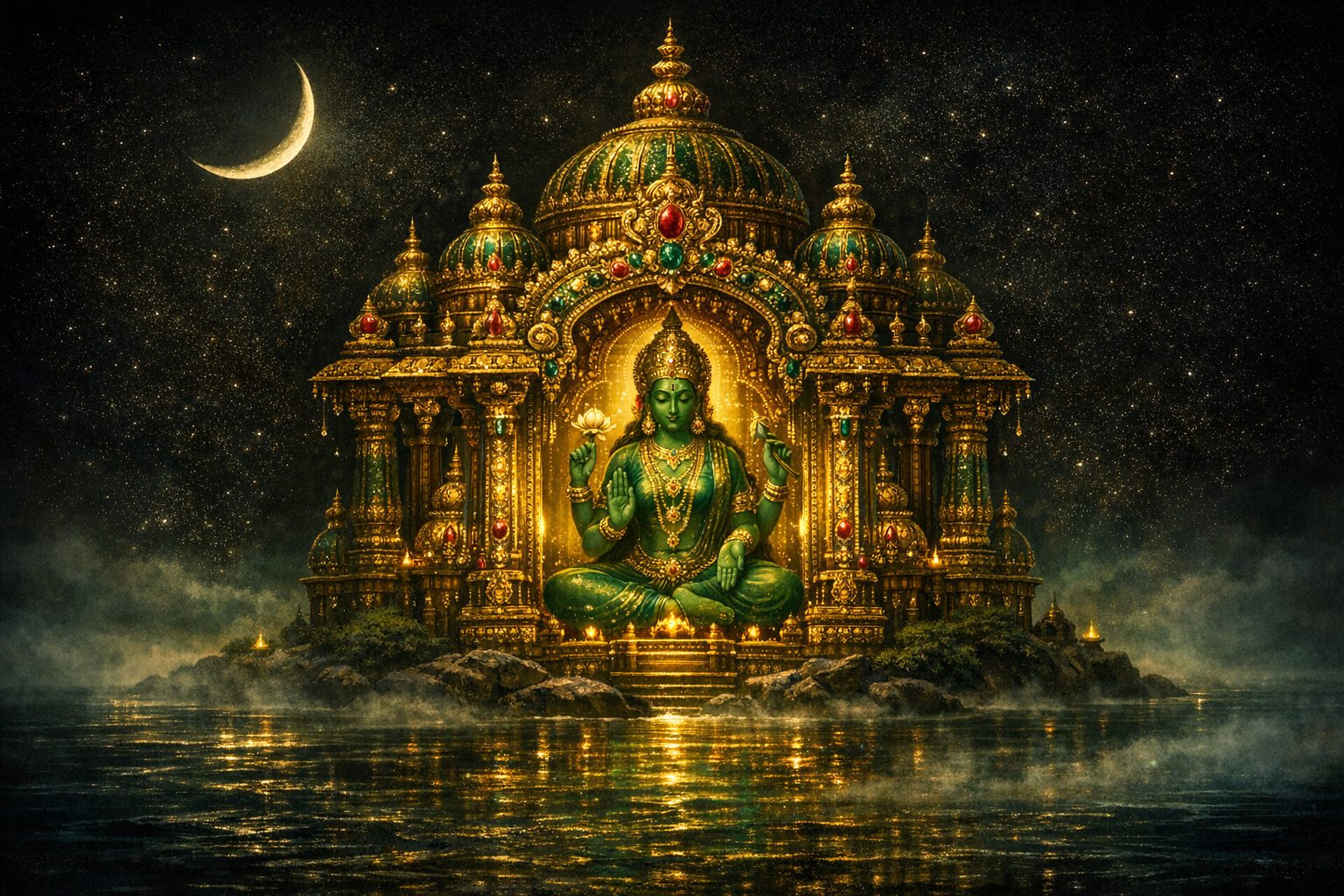
Who Is Ma Matangi
The Outcaste Oracle
Ninth Mahavidya — goddess of speech, music, wisdom, creativity, and the knowledge that lives outside every sanctioned boundary
Origin & Identity
Dark mirror of Saraswati. Tongue of the Absolute.
Matangi is the ninth of the Ten Mahavidyas — the tantric manifestations of Mahadevi, the supreme goddess. Where her counterpart Saraswati governs sanctioned knowledge, pure learning, and institutionally acceptable wisdom, Matangi rules what is forbidden, transgressive, and marginal.
She is specifically identified as a Chandali — the feminine outcast who lives outside the village boundary, beyond the walls of conventional society. This is not a flaw in her mythology. It is the central teaching: the highest wisdom does not flow through authorized channels. It flows through the margins, the discarded, the supposedly contaminated.
She accepts ucchishta — offerings that have been touched, eaten, made impure by contact with life. In doing so, she inverts the entire logic of purity-based worship: the sacred dwells not in the pristine, but in what has been fully lived.
Core Attributes
Origin Myth
How the Outcaste Became the Oracle
Once, when Vishnu and Shiva sat together with their consorts, Vishnu offered food to them as a gesture of devotion. After Shiva and Parvati had eaten, from the leftover — the ucchishta — arose a dark, beautiful woman redolent with the fragrance of kadamba flowers, wine-flushed, wearing red, with wild unbound hair. She declared: "I am the power born from what remains. I am the wisdom that lives inside the discarded."
In another telling, Parvati and Shiva engaged in a game of disguises to test each other's faithfulness. Shiva disguised himself as a chandala — an outcast — selling ornaments. Parvati disguised herself as a chandali huntress: lean, wide-eyed, dancing at his threshold in red clothing. When he asked who she was, she said: "I am the daughter of an outcast. I have come to do penance." Shiva — recognizing in her disguise the ultimate teaching about where wisdom actually lives — became himself a chandala to match her. From their union in outcast form, the Matangi current was established.
The transmission is precise: the divine does not preserve itself through purity. It descends into the margin, the threshold, the rejected space. The sacred is not protected by keeping it clean. It is activated by its contact with the fullness of life.
Sacred Iconography
Her Sacred Attributes
वीणा
Veena
The divine instrument through which she transmits knowledge that transcends ordinary teaching. Every string vibrates at a different frequency of truth.
Creative intelligence, the bridge between thought and manifestation
शुक
Parrot
Her constant companion who echoes her mantras into the world. Symbolizes the power of sacred repetition — how truth, repeated, reshapes reality.
Vak siddhi, the magic of speech that creates
पाश
Noose
The cord that binds obstacles and captures wandering attention, drawing the practitioner toward liberation.
Focused will, binding of distraction
अंकुश
Goad
The divine stimulus that prods the practitioner past inertia. Precise sacred pressure applied at the exact right moment.
Awakening, the spark that initiates movement
खड्ग
Sword
The blade that severs illusion and cuts through the constructed hierarchies of purity and pollution that limit understanding.
Discrimination, liberation through cutting away falsity
कपाल
Skull Cup
The vessel of transformation — what was once feared becomes sacred offering. The vessel of ego-dissolution.
Transformation of the feared into the sacred
श्यामा
Emerald Form
Her green luminescence represents the living intelligence of nature — raw creative force that is not tamed, not domesticated, not reducible to institution.
Vital creative power, the intelligence of the wild
चन्द्रकला
Crescent Moon
She wears the crescent at her crown — the liminal between dark and light, the boundary state where revelation becomes possible.
Liminality, the threshold between states
Five Sacred Forms
Manifestations of the Goddess
Each form governs a different aspect of the same domain — five octaves of the same fundamental transmission.
Ucchishta-Matangini
She Who Accepts What Has Been Touched
The most widely worshipped form. She stands with wild unbound hair, holding sword, goad, noose, and club. Her eyes are red — not with rage but with the intoxication of understanding that purity hierarchies are power structures, not truths. She accepts the leftover.
POWERS
Liberation from purity obsession, transformation of shame, honoring the full reality of lived experience
Raja-Matangi
The Royal Sovereign of Speech
The royal form — seated on a jeweled throne surrounded by parrots who endlessly echo her mantras. She holds the veena, radiating absolute sovereign authority over all forms of expression. The parrots are not decoration; they are the mechanism by which her transmission propagates through the world.
POWERS
Mastery over arts, eloquence, authority in speech, the gift of being truly heard
Sumukhi-Matangi
She of the Beautiful Countenance
The auspicious form invoked for attraction and grace. Sumukhi means "beautiful face" — but this beauty is a form of intelligence, not ornament. She governs the magnetism that draws the right teachers, students, and creative collaborators into one's field.
POWERS
Attraction, grace, the beauty of thought made visible, drawing the right relationships
Vasya-Matangi
She Who Commands Through Truth
The form of influence and command. She grants the power to move people through authentic speech — not manipulation but the irresistible pull of a truth so clearly expressed that resistance dissolves. The Matangi of negotiators, healers, and teachers.
POWERS
Command, influence, bringing harmony, resolving conflict through the precision of language
Karna-Matangi
She Who Listens
The most interior and least-known form. Karna means "ear." Before speech can be mastered, listening must be mastered. This is Matangi as the power of sacred receptivity — the capacity to hear what is not being said, to receive transmissions hidden inside ordinary sound.
POWERS
Clairaudience, deep listening, hearing the oracle within the noise, understanding what is left unspoken
Spiritual Gifts
Siddhis — Attainments of Practice
Presented as contemplative ideals and directional qualities of development — not supernatural promises.
Vak Siddhi
Perfection of speech — words spoken manifest in reality
Sarva Jana Vashya
The power to move people through authentic expression
Saraswati Avahana
Direct access to creative inspiration, the unbidden Muse
Shatru Stambhana
Silencing opposition with the exactly right word
Kavi Shakti
Poetic compression — truth expressed in minimum syllables
Smriti Siddhi
Perfect retention of all knowledge encountered or heard
Divine Context
The Ten Mahavidyas
Matangi is the ninth — the penultimate transgression before the final integration.
Tantric Context
Daśa Mahāvidyā — The Ten Disciplines
The Daśa Mahāvidyā-s are ten types of disciplines to reach the ultimate goal of spiritual life. All ten are known as Brahma Vidyā. Every sādhana takes the sādhaka forward towards the highest spiritual attainment — liberation — in successive stages. Sādhana means "leading straight to a goal" — bringing about, carrying out, accomplishing, fulfilling, completing, and perfecting spiritual practices. Sādhana is not merely ritualistic worship; it begins with ritualistic worship and over time realizes that the body is the temple and the Self within is the Sanctum Sanctorum.
Śiva and Śaktī — The Foundation
Śiva is always Self-effulgent and hence is addressed as Prakāśa (Light). Śaktī is His Power to distribute His Light so that the universe is made visible. She is Vimarśa — cognizance. Light without cognizance and cognizance without light is of no use. Based on this principle, Śiva and Śaktī are always interdependent and inherent (prakāśa vimarśa sāmarasyātmaka parabrahmasvarūpiṇī).
In a human being, Śiva exists as the Soul and Śaktī exists as Māyā. As Soul and Māyā, they are inseparable. However, the separation happens at the time of realization of the Self — Śaktī moves away, revealing the True Nature of Śiva, which can be revealed only by Her. Towards the final stages of Self-realization, She becomes the Guru (Gurumūrtiḥ) to the aspirant and imparts the knowledge of Śiva. She is Śiva-jñāna-pradāyinī.
Śiva is static energy and His own power Śaktī (Svātantrya Śaktī) is kinetic energy. They are also known as Nirguṇa Brahman and Saguṇa Brahman. Only after realising Saguṇa Brahman can one merge into Nirguṇa Brahman — the purest form of Consciousness. The main purpose of worshipping Her is to get Her Grace to merge unto Śiva (She is kaivalyapadadāyinī).
The Tantric Understanding
Arthur Avlon said: "The Tantra has no notion of some separate far-seeing God. It preaches no such doctrine as that God rules the Universe from heaven. In the eye of the Tantra, the body of the sādhaka is the Universe." The ātmaśaktī within the body is what is sought for — it is the deity of the sādhaka, often called as Iṣṭa Devatā.
Tantra śāstras attach more importance to Consciousness, attained through the puruṣārthas — the fourfold values of human life: dharma (righteousness), artha (purpose), kāma (desires and pleasures), and mokṣa (liberation). What they say is not to prohibit these great human values, but not to get attached to them.
According to Tantra śāstras, the spiritual path cannot exist independently of the hedonic path — there should be harmonious integration between the two. Only then can the pinnacle of spirituality be attained along with material comforts through rightful means. Without body, how can we work on breath and mind to realize Śiva within?
Tantra accepts desire as the sole motivating force of the universe and does not advocate renunciation of desires. This is the significant difference between Vedanta and Tantra.
Mātaṅgī and Vaikharī — The Final Stage of Speech
Mātaṅgī is said to be superior to Goddess Sarasvatī, as Mātaṅgī is in charge of Vaikharī — the final stage of sound, at the time of its delivery, in the form of speech.
Vaikharī is the fourth and final form of sound in its evolution. This is the state wherein sound is heard. It is called Vaikharī because the sound is produced by a modified form of prāṇa called vaikharī. This is the aparā or non-supreme stage in the evolution of sound, where there exists fully developed materialization combined with time and space — the components of Māyā.
The theory of evolution of speech depends purely upon the materialistic treatment of prāṇa or life energy. The whispering sound of the Madhyamā stage fully transforms into speech and is delivered in the form of Vaikharī. It is said that will (icchā) forms the basis of speech to finally merge with consciousness.
The four stages of sound are: • Parā — the ultimate transcendent vibration, beyond perception • Paśyantī — the seeing/luminous stage, where intention forms • Madhyamā — the middle stage, inner speech before articulation • Vaikharī — the final, heard, delivered speech
The important difference between Sarasvatī and Mātaṅgī: Sarasvatī is related to materialistic and scriptural knowledge, whereas Mātaṅgī gives inner knowledge to know the Self. Mātaṅgī dissolves all dyads and triads, leading to the unveiling of Māyā. She imparts the highest spiritual knowledge: "nothing is good and nothing is bad, as Brahman is omnipresent." Since she is considered as Śyāmalā, she also controls all mantras.
Transcendent vibration beyond perception — the absolute before any manifestation
The seeing stage — where intention forms and the impulse to speak arises
The middle stage — inner speech, thought forming before articulation
The delivered speech — Mātaṅgī's domain — sound fully materialized in time and space
धर्म
Dharma
Righteousness, virtues, the Law of Nature
Not merely scriptural dictums — Dharma typically means the Law of Nature. We must go with Prakṛti. As long as the triads are within the Law of Nature, nothing will go wrong.
अर्थ
Artha
Wish, purpose, material wellbeing
Not condemned but to be pursued without attachment — the legitimate means of sustaining life and spiritual practice.
काम
Kāma
Desire, pleasure, love
Tantra accepts desire as the sole motivating force of the universe. The key is not renunciation but right relationship — spontaneous, authentic engagement without bondage.
मोक्ष
Mokṣa
Liberation from the cycle of existence
The ultimate goal — not escape from life but the full recognition of the Self as Brahman. Mātaṅgī's path to Mokṣa runs directly through the transgressive, the discarded, the liminal.
There are different views about the origin of the Daśa Mahāvidyās, all relating to the Purāṇas. One account: Śiva was not courting Satī after she decided to attend a Yajña conducted by her father Dakṣa. Satī became terribly wrathful, which was reflected in Her eyes. As Śiva could not see Her wrathful red eyes, He closed His eyes. When He opened them again, He saw a woman with blistering luminosity. Śiva was so frightened He started running. To ensure Śiva did not move away, She manifested in ten different forms — and when Śiva asked who they were, She said they are known as Kālī, Tārā, Ṣoḍaśī, Bhuvaneśvarī, Chinnamastā, Tripurabhairavī, Dhūmavatī, Bagalāmukhī, Mātaṅgī and Kamalā.
What is important to note: all these worships lead to Parāśaktī — the source of all gods and goddesses and their allocated powers. From Her proceeds everything else. She is the Independent and Absolute Power of Paramaśiva, and only through Her Grace is merging unto Paramaśiva possible for liberation.
Understanding who she is prepares you to receive what she teaches.